Do Commercial Cleaners Bring Their Own Supplies?
Whether commercial cleaners bring products and equipment depends on the written scope. Separate cleaning products, reusable equipment and washroom consumables so each item has an agreed supplier, storage arrangement and replenishment responsibility.
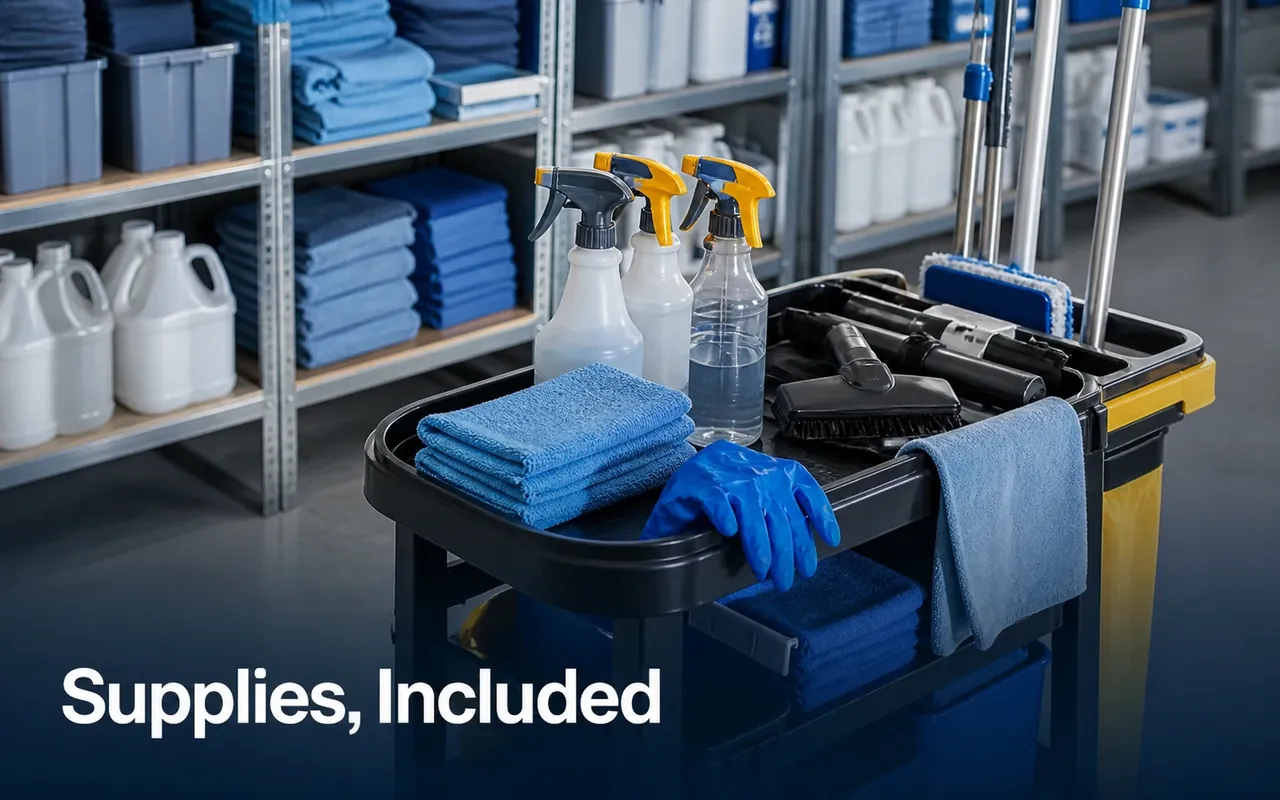
Which supplies are different from cleaning equipment?
Separate products used to perform the cleaning from items consumed by building occupants. Cleaning products and reusable equipment support the work; toilet tissue, hand soap and paper towels need their own purchasing and replenishment arrangement.
Make the list specific enough to assign responsibility. Instead of writing supplies included, identify whether the proposal covers products, cloths, mop equipment, vacuuming equipment, bin liners and washroom stock. A clear list prevents two parties from each assuming the other will place the next order.
What does YEG commercial cleaners cleaning estimate allow for?
The current planning estimate includes routine labour, ordinary cleaning products and equipment within its stated allowance. Consumables, initial deep cleaning and specialty work are assessed separately. These estimate assumptions still need to be reflected in the final facility scope.
Read the cleaning price assumptions before comparing the total with another proposal. An apparently lower monthly figure may include a different supplies arrangement. Compare the work and responsibility together rather than treating one included item as proof that the whole offer is equivalent.
What if the facility requires particular cleaning products?
Provide the product or surface restrictions before the walkthrough. Name the affected rooms and surfaces, explain who approves the method and make the applicable manufacturer or facility instructions available. Do not assume that a general preference establishes compatibility with every floor, finish or piece of equipment.
Ask the provider to identify any effect on equipment, preparation or workload. A product restriction should become a clear scope condition rather than an informal note that one person remembers. The aim is to agree on the method before work begins.
Where should cleaning supplies be stored?
Agree whether equipment arrives with the team or uses a designated storage area at the facility. If storage is on site, identify the space, access arrangements, permitted contents and responsibility for keeping it organized. Confirm access to any water or utility point needed for the agreed work.
For a multi-tenant office, also clarify which items belong to the tenant and which belong to the building. Add these details to the office checklist and access notes so a replacement contact can understand the arrangement.
Who checks stock and handles supply shortages?
Assign purchasing, stock checks and replenishment separately. A cleaner may be asked to report low stock without being responsible for buying it. The agreement should identify the notification recipient and how an unavailable item will be recorded during a visit.
For after-hours commercial cleaning, decide who handles a shortage during operating hours between scheduled visits. Keep a practical ordering threshold based on the facility's own use and lead time. There is no single stock level that suits every office or dispenser.