FACILITY PLANNING
Office Waste and Recycling Collection Handoff
An office waste handoff should identify which bins the cleaner empties, where each stream goes inside the building and who arranges off-site collection. Use the building’s actual commercial service agreement; household collection instructions are not a substitute.
Open the planning toolYEG commercial cleaners / WORKING TOOLS
Waste handoff planner
Enter your planning inputs to calculate results and see which decisions still need confirmation.
Opening the planning tool…
Which Edmonton waste guidance applies to offices?
As checked on September 8, 2026, Edmonton’s industrial, commercial and institutional waste page says businesses are not currently required by the City to separate streams in the same way residents are. It encourages organizations to discuss recycling and food-scrap services with their waste provider. Confirm current requirements and the actual building agreement before changing collection.
For mixed-use properties, the City’s communal collection guide says a business on the property needs its own waste containers and private collection. Do not send office waste to residential containers simply because they are nearby.
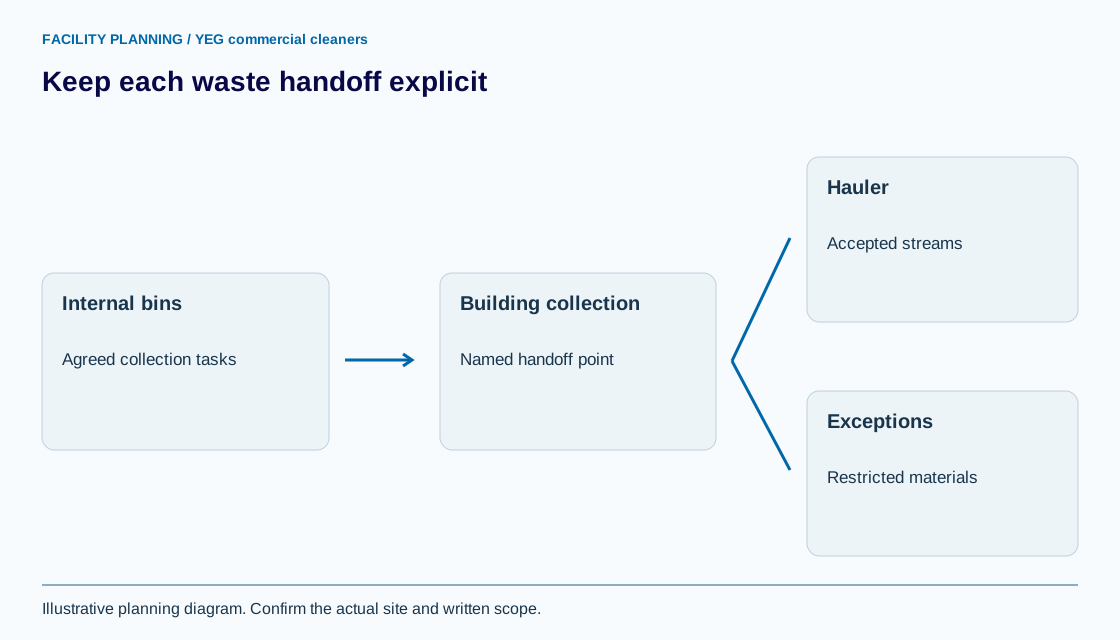
Record the building and tenant boundaries in the property management cleaning scope, with a named collection point for the cleaner and a separate hauler responsibility.
How should the internal collection route be recorded?
List workstation bins, shared stations and the building’s collection points. Give each a location ID, stream, accepted-material reference and access requirement. Name who supplies liners, replaces damaged bins and keeps the storage area accessible.
Record the boundary of the cleaning task: moving an agreed office bag to an authorized internal collection point is different from hauling waste off site. If a service agreement includes only the first activity, the second needs its own provider and arrangement.
Who confirms what belongs in each stream?
Use the accepted-material list from the contracted building or waste provider. Record the list’s date and where staff can find it. Do not assume every hauler accepts the same packaging, liners or food-contaminated material.
If an item is uncertain, use the agreed exception route instead of guessing. Confidential records, sharps, batteries, chemicals and construction waste should be assigned to their designated handling arrangements; they are not automatically part of routine office-bin collection. The worksheet records ownership rather than prescribing disposal for an unidentified material.
What happens when a collection point is unavailable?
Agree who is contacted if the storage area is locked, a container is full or the scheduled pickup has not happened. Record a permitted alternative only when the building has approved one. Do not leave bags in an exit route or improvise a different tenant’s container.
CCOHS housekeeping guidance emphasizes planned storage, waste removal and clear passageways. Translate that into a named building response rather than treating an overflowing collection point as another task the cleaner can solve without authority.
How does waste handling enter the cleaning agreement?
Attach the route and responsibility sheet to the scope of work. Use the service calendar to distinguish contracted collection nights from site-owned needs between visits. YEG commercial cleaners cleans during closed hours and does not provide daytime porter service.
For several tenants or locations, use the multi-site RFP template to keep each building’s rules separate. Bring waste access and collection-point details to the facility walkthrough; a recurring cleaning estimate is not a waste-hauling quote.
YOUR WORKING DOCUMENT
Commercial bin-to-collection-point handoff plan
Adapt the fields to your facility. These planning entries are editable in this tab. Download your work before leaving; it is not sent to YEG commercial cleaners or saved automatically.
Swipe or scroll across the table to reach every field.
| Bin / stream / location | Authorized collection point | Accepted-material reference | Cleaner / building / hauler owner | Exception contact |
|---|---|---|---|---|
A template supports the discussion; the accepted written scope determines the work.
Sources and review
Reviewed September 8, 2026. Source links support the statements beside them. The worksheet is an original planning aid; confirm site requirements and current product instructions before use.
Use this information in your cleaning scope
Use the property management cleaning scope to take the next planning step. Identify the quantities, access conditions and exclusions that apply before requesting a price.