FACILITY PLANNING
Estimate Commercial Cleaning Labour Hours
Estimate cleaning labour by listing the work, measuring its quantities and applying a justified time to each task. Add the cleaner-minutes once, then convert them to hours. Square footage alone cannot tell you how many desks, fixtures or restricted areas need attention.
Open the planning toolYEG commercial cleaners / WORKING TOOLS
Workload and budget calculator
Enter your planning inputs to calculate results and see which decisions still need confirmation.
Opening the planning tool…
What quantities belong in a cleaning workload?
Record cleanable floor area by room and floor type, then count objects that area does not describe. Desks, sinks and toilets need their own quantities. ISSA’s workloading method distinguishes cleanable space from gross building area and connects the inventory to task frequency.
Use one unit per row: square feet for floor area, fixtures for a defined washroom bundle, or individual workstations for an agreed desk task. Keep the measurement date and exclusions beside the quantity. A leased area that includes inaccessible storage should not silently become vacuumable floor area.
Which task timings can support an estimate?
A timing needs a matching task, tool and scope. ISSA’s published example uses a 14-inch flat mop with a dual-chamber bucket at 5,355 sq ft per hour: 1,000 ÷ 5,355 × 60 is about 11.2 cleaner-minutes. That is an illustrative mopping calculation, not a complete office visit or a measured YEG commercial cleaners production rate.
If workstation, glass or setup time is unknown, write “timing to confirm”. Do not insert zero to make the total look complete. A provisional operator input needs its unit, author, date, conditions and explanation; entering it does not make it a validated tariff.
How do you avoid counting the same work twice?
Assign each surface or task to one row. In the YEG commercial cleaners visualizer, a whole-washroom bundle owns that room’s floors, mirrors, bins and restocking as well as fixtures. Do not add those items again. Outside that bundle, removing loose floor soil and damp mopping are different tasks.
Record arrival, equipment handling, final check and lock-up once for the visit. If a published bundle already includes a component, mark the separate row “included in bundle”, rather than charging for both. The scope-of-work template provides the ownership record.
How are cleaner-hours different from elapsed time?
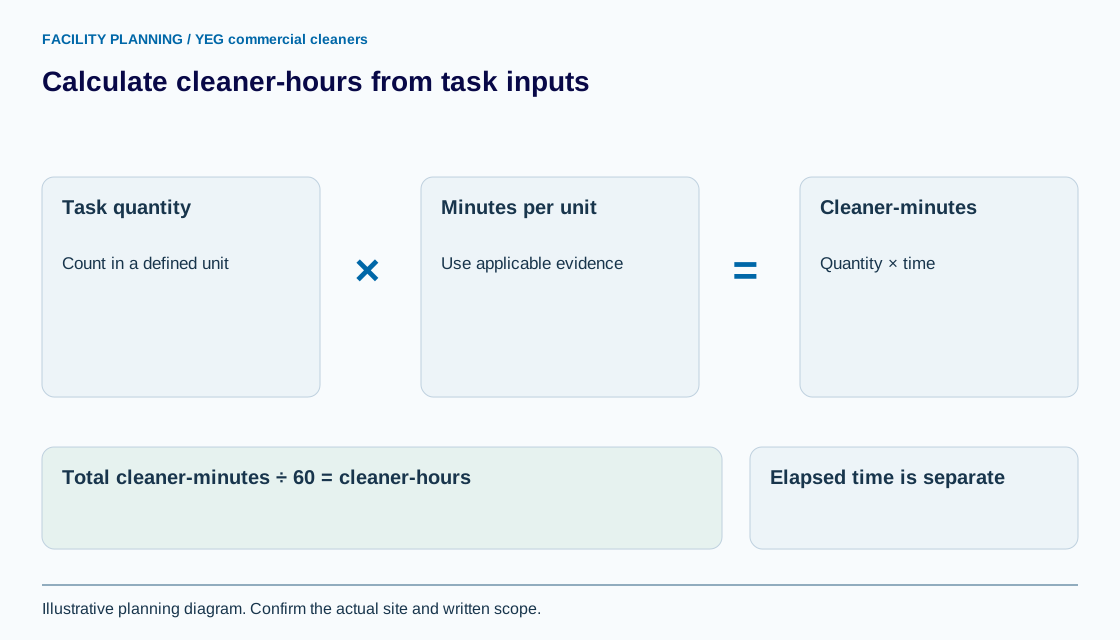
Cleaner-hours add the time worked by each person. Illustrative arithmetic: two cleaners working for two hours contribute four cleaner-hours. It does not follow that any four-hour task list fits a two-hour access window: some activities, equipment or drying conditions prevent parallel work.
For each row, multiply quantity by cleaner-minutes per unit, then divide the total minutes by 60. Record elapsed access time separately. Use the weekly schedule worksheet to check whether the plan fits the building’s actual closed hours.
How does workload become a YEG commercial cleaners planning budget?
YEG commercial cleaners current planning policy uses $58–$64 CAD per cleaner-hour and a 2.5-hour minimum for a nonempty, fully calculable visit. The minimum applies once, not to every task. Per-visit bounds round upward to $5; monthly visits use weekly frequency × 52 ÷ 12. Estimates are before applicable GST.
The quick office model’s 4–5.5 cleaner-hours at 5,000 sq ft is a selected whole-office allowance. It does not prove individual task rates. The visualizer withholds a complete price while a selected timing remains unresolved. Review the pricing methodology, then use your completed workload inventory to request a site-specific walkthrough.
YOUR WORKING DOCUMENT
Cleaning workload inventory; enter measured inputs
Adapt the fields to your facility. These planning entries are editable in this tab. Download your work before leaving; it is not sent to YEG commercial cleaners or saved automatically.
Swipe or scroll across the table to reach every field.
| Room / task | Quantity and unit | Minutes per unit / source | Calculated cleaner-minutes | Included elsewhere / unresolved |
|---|---|---|---|---|
A template supports the discussion; the accepted written scope determines the work.
Sources and review
Reviewed September 8, 2026. Source links support the statements beside them. The worksheet is an original planning aid; confirm site requirements and current product instructions before use.
Use this information in your cleaning scope
Use the cleaning pricing methodology to take the next planning step. Identify the quantities, access conditions and exclusions that apply before requesting a price.